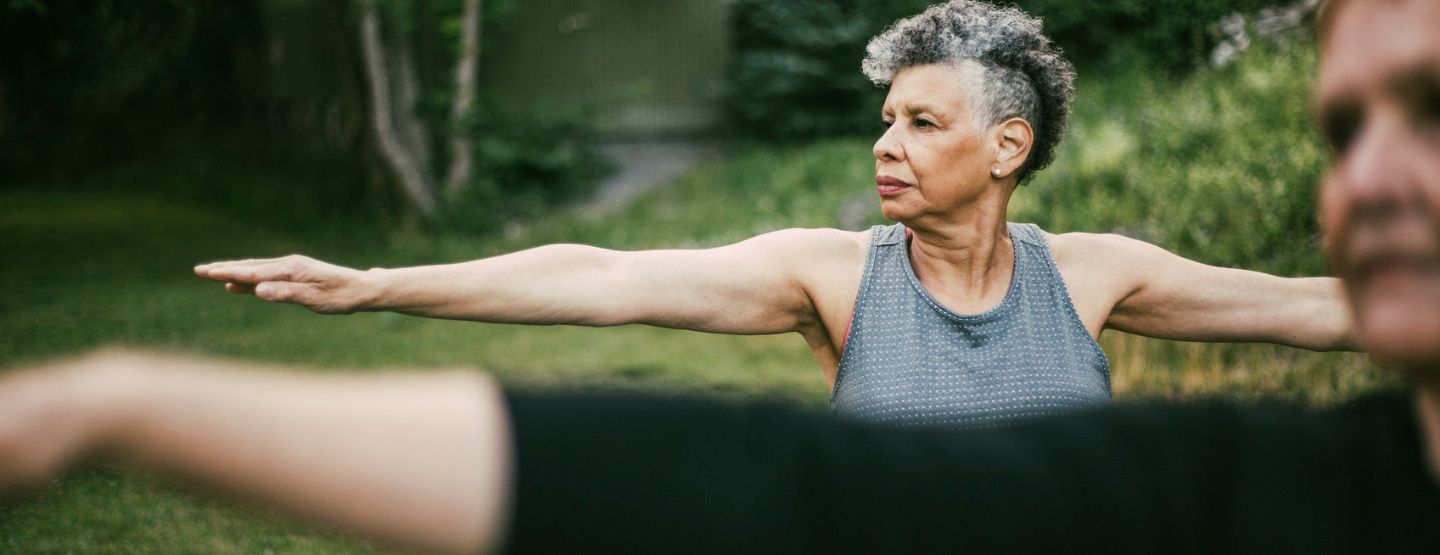
Ann Heckler, a yoga instructor with ProMedica ForeverFit, recalls a time when yoga wasn’t a mainstream form of exercise. Just within the past few decades, yoga grew beyond a spiritual practice and began to be recognized for its physical fitness and mental health benefits. Why is this form of movement so powerful?
Yoga: A Marriage of Two Disciplines
Yoga is different from other forms of exercise because it incorporates the disciplines of balance and breathwork.
Balance
In yoga, balance doesn’t just involve contorting your body into a difficult pose and holding still. It’s about evening out the strength and flexibility of your muscles and learning to ground yourself to the earth.
Heckler recalls a mountain pose, a standing position where you stand up straight and let your arms hang naturally at your sides. The pose looks simple at first glance, but when done correctly, is doing much more than what meets the eye. “Although it may look like you’re just standing there, you’re working on your posture, standing firm on your feet and checking in on how your body is feeling.”
Breathwork
Another important part of yoga is focusing on your breathing and keeping your breath steady and consistent throughout the whole practice. “Breathwork teaches you how to divide your attention in a focused way between two things – your breath and what needs to be done,” Heckler shares. “Focusing on your breath can help you relax and increase your awareness of your body and surroundings.”
The Benefits of Yoga
Mindfulness and Confidence
A consistent practice focusing on these two disciplines – balance and breathwork – creates mindfulness and confidence.
“If you feel vulnerable in your gait – whether that’s due to an injury, past fall or unsteady terrain – you’re going to feel more anxious and, as a result, be less aware,” Heckler explains.
Practicing yoga and improving balance helps you feel more confident in taking on tricky terrain, whether that’s a mountain trail or an icy driveway. By working on your breath, you will find more mindfulness, leading to a greater awareness of your body and surroundings.
Non-Judgmental Awareness
Through yoga, you can slowly and mindfully discover things that need to be worked on in your body – whether that is a lack of flexibility or balance, or uneven muscle tone on one side of your body compared to the other. But it’s important to notice these things without judging the body or ourselves.
“Yoga cultivates body awareness that takes you into having a safer gait, better balance and improved physicality,” Heckler shares. “Through yoga, we work on developing non-judgmental awareness of our own bodies.”
Yoga Is for Everyone
“Anyone can do yoga. Whether you’re eight years old or 93, a young athlete or a retiree, there’s a yoga practice for you,” Heckler explains.
Whether it’s a fast-paced class that doubles as cardio (power yoga), or a more laid-back class that offers additional body support (chair yoga), all yoga variations offer restorative benefits.
“Try a class. If it’s not a good fit, try something else. One size doesn’t fit all in yoga – don’t give up on it because one style of yoga or an instructor doesn’t fit what you’re looking for,” Heckler encourages.
Subscribe to Our ProMedica Newsletter
Looking for inspiration on how to improve your health and well-being? Get trustworthy health news, wellness tips and inspirational patient stories delivered to your inbox twice a month with our free ProMedica newsletter.