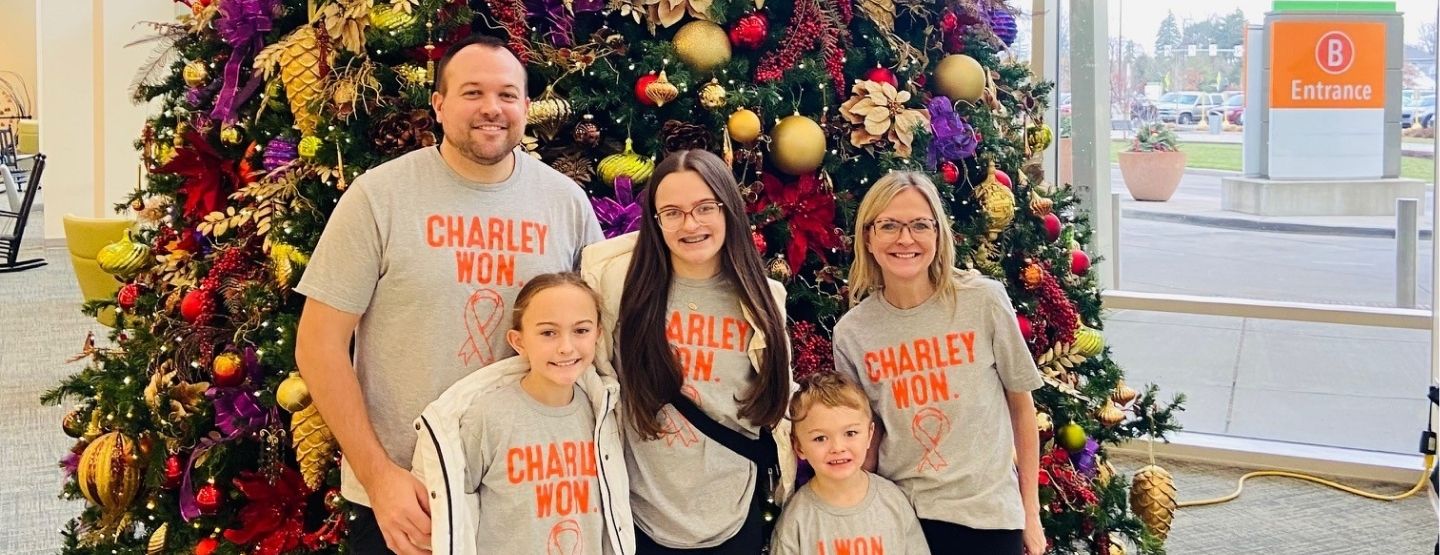
Charley Myers was just four years old when a routine doctor’s visit and blood work led to a shocking discovery: he had leukemia. Immediately, he was offered chemotherapy treatment, as well as the opportunity to be part of a pediatric clinical trial at ProMedica Russell J. Ebeid Children’s Hospital. The trial was for a medicine called blinatumomab, which could help Charley’s own immune system fight cancerous cells.
Now, Charley is a cancer-free six-year-old, and his participation in the clinical study led to remarkable results. Three years after chemotherapy plus blinatumomab treatment, 96% of the child participants in the study group were cancer-free, compared to 87.9% from the group that had chemotherapy alone.
A Shocking Diagnosis, A Difficult Decision
Like all children in the clinical study, Charley had B-cell acute lymphoblastic leukemia (B-cell ALL). This type of blood cancer causes the rapid production of immature B cells, a type of white blood cell. Although it’s a rare disease, it’s the most common cancer in children.
According to Charley’s mom, Alissa, there weren’t any signs of cancer before they received Charley’s blood test results.
“His leukemia diagnosis was completely a shock to us,” says Alissa. He was a typical 4-year-old boy at the time, and even throughout his treatment, he’s been the most energetic boy, always playing.”
After two rounds of chemotherapy, Alissa and her husband, Chad, faced the difficult decision of whether to allow Charley to participate in the blinatumomab clinical study. At first, they weren’t sure they wanted to move forward.
“It meant that our little boy had to be hooked up to a backpack with medicine for 28 days straight,” explains Alissa. “But then we thought, what if we don’t do it and he doesn’t get better? We had to try every possible thing we could to help him.”
Starting the Blinatumomab Clinical Study
Anthony Palmer, MD, a pediatric hematologist/oncologist with ProMedica Physicians, explains that blinatumomab itself is not a new medication. However, it’s rather new as a frontline management in pediatric cancer care.
Blinatumomab is a bispecific T-cell engager. That means one end of the molecule attaches to B cells. The other end attracts T cells, which are part of the immune system. In other words, it attracts a person’s own immune system to target B cells, which are affected by B-cell ALL.
“It’s using your own body’s immune system, without having to add additional or more intense chemotherapy,” explains Dr. Palmer. “Generally speaking, the push now in oncology is to try to move away from traditional, toxic chemotherapies and more into immunotherapies that harness your own immune system.”
Most study participants were between the ages of one and nine years old, but the study was also open to patients with Down syndrome up to age 31 with B-cell ALL. That’s because those with Down syndrome tend to have more side effects with traditional chemotherapy. All participants were randomized into two groups: those who would be treated with chemotherapy and blinatumomab, and those who would receive the standard treatment of chemotherapy alone.
Charley was randomly chosen to receive blinatumomab. The following week, he went to Ebeid Children’s Hospital to start his treatment. His port, which he had previously received for chemotherapy, was connected to an IV bag, giving him continuous infusion for weeks.
For 28 days straight, Charley was attached to his backpack – during bath time, during bedtime and while playing. His parents and his older sisters, Molly and Lily, helped him adjust.
“There were many times we had to remind him, ‘Charley, get your backpack!’” Alissa recalls, laughing. “But Charley was much better at it than we envisioned. As soon as he would run out of cord, he’d grab his backpack. It was still really hard, but he was resilient.”
Great Outcomes Lead to Increased Use
Charley had two rounds of blinatumomab: once in the fall of 2022 and again in the spring of 2023. Each week while on the immunotherapy, he went to Ebeid Children’s Hospital twice to get his IV bag refilled. He, like all the study participants, still received the standard chemotherapy he would have received had he not participated in the study.
Thankfully, Charley tolerated blinatumomab very well, and without any side effects. In January 2025, he rang the bell and is now cancer-free.
And the outcomes of the study? They were remarkable.
“Because the numbers were so favorable for the patients who received blinatumomab, the decision was made to end the study early,” says Dr. Palmer. “We were given recommendations that we could follow for patients who were not yet in the maintenance phase. The results were so positive that we wanted to get as many patients as possible into that additional blinatumomab treatment.”
Even patients with a higher risk for relapse showed more favorable outcomes. Three years after treatment, the percentage of those patients who did not have relapse increased from 84.8% to 94.1%.
“When we found out that the study worked and was going to be part of standard treatment, and that all that data had been collected and Charley was a part of it – it was a huge deal for us,” Alissa says. “We are so excited that he could be part of research that is going to help other kids.”
Cutting Edge Children’s Cancer Therapies
“Here at ProMedica, our patients are benefiting from access to cutting-edge clinical trials and research that are ongoing nationally that we can offer them right here in Toledo,” says Dr. Palmer. “Because of our participation with the Children’s Oncology Group, we’re able to offer these types of opportunities to our patients to help them have the best chance at long-term cures.”
The Children’s Oncology Group is the world’s largest organization devoted exclusively to childhood and adolescent cancer research. The group has more than 100 active clinical trials open at any given time, with more than 12,000 registered patients annually.
Alissa knows the choice to enroll your child in a clinical study can be difficult, but she and her family are glad they said yes.
She says, “It’s terrifying because your kid is hooked up to an IV bag for 28 days, but it’s worth it in the long run if it’s going to make them better. Your child is resilient, and they’ll be able to handle it just fine.”
“Working with families and their children who have cancer is never easy. It’s always some of the hardest times of the family’s lives,” says Dr. Palmer. “Even though it’s challenging to get them through treatment, the vast majority do very well long term. That makes our work so satisfying.”
“We were very proud to be part of this study and glad that the hospital offered it to us when Charley was first diagnosed,” Alissa shares. “I can’t say enough about Ebeid Children’s Hospital. They are proactive in finding treatments for kids, and the care team – all the doctors and nurses – is amazing.”
Subscribe to Our ProMedica Newsletter
Looking for inspiration on how to improve your health and well-being? Get trustworthy health news, wellness tips and inspirational patient stories delivered to your inbox twice a month with our free ProMedica newsletter.