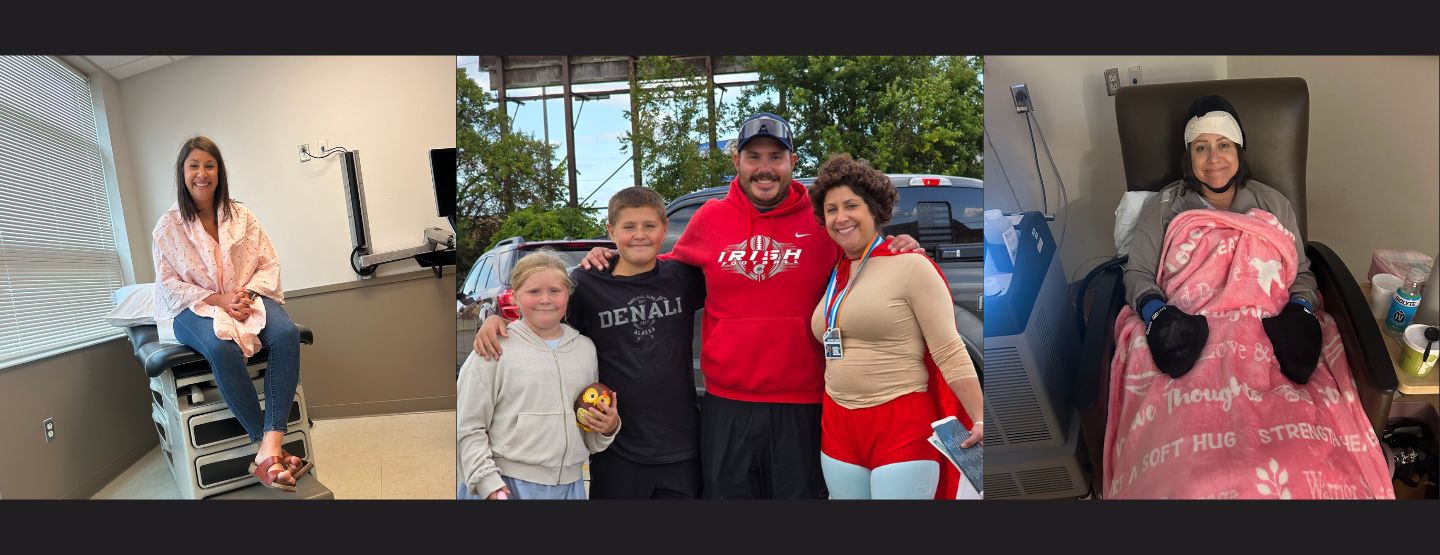
When Kayla Carr first heard the words “you have breast cancer,” her world stopped.
“I instantly ran out to my car and called my husband,” Kayla shares. “I was a mess. I had never been close to anyone who had gone through breast cancer. I truly felt like we were walking into the unknown.”
Like many patients, Kayla’s diagnosis quickly turned into a whirlwind of appointments, tests and treatment decisions — all while trying to keep life moving forward for her family.
But one appointment changed everything. When Kayla met with Jessica Burns, MD, a breast surgeon with ProMedica Physicians, she finally felt like she understood what was happening and what would come next.
“That appointment changed everything for me,” Kayla shares. “Dr. Burns took so much time with me and my husband — explaining what was happening in my body and walking me through what different treatment paths could look like. It wasn’t until after that appointment that I felt like I could breathe.”
Navigating Treatment and Important Decisions
Kayla’s treatment plan included chemotherapy, surgery, radiation therapy and genetic testing. When testing revealed she was BRCA1 positive — despite no known family history of breast cancer — it reshaped her surgical decisions and long term care plan.
Patients with the BRCA1 gene mutation have a high risk of developing certain cancers, specifically breast and ovarian cancer. Their high risk influences the recommended treatment plan to reduce their risk of future cancers.
Jessica Burns, MD, a breast surgeon with ProMedica Physicians, explains, “For these patients with BRCA1 or BRCA2 mutations, we focus on early detection with special screening regimens. For some patients, we may offer more aggressive risk reducing measures, such as a mastectomy.”
After completing chemotherapy, Kayla underwent a double mastectomy with direct to implant breast reconstruction. At the time, implants were the right option, but Kayla knew that they would be a temporary solution for her.
As she looked ahead to the next phase of breast reconstruction, Kayla wanted to choose a reconstruction technique that would help her feel more like herself again.
Choosing DIEP Flap Reconstruction
Kayla ultimately chose DIEP (deep inferior epigastric perforator) flap reconstruction. This type of breast reconstruction uses a patient’s own tissue, rather than implants, to rebuild the breast. Tissue is typically taken from the lower abdomen, allowing surgeons to create a more natural-looking breast without sacrificing core muscle.
“I just didn’t feel like myself with the implants,” Kayla says. “To have the opportunity to use my own body to feel more like myself was appealing to me.”
Her DIEP procedure was performed by Tahir Jamil, MD, a robotic surgeon with ProMedica Physicians, and Kristoffer Sugg, MD, a plastic and reconstructive surgeon with ProMedica Physicians.
“Overall, DIEP flap reconstructions have been shown to lead to more natural-appearing reconstructions compared to reconstructions using implants,” explains Dr. Sugg. “Unlike implant-based reconstructions, no long-term maintenance is required, and the patient's own tissue will grow and change with them over time.”
DIEP flap reconstructions have also been shown to lead to fewer complications in patients who have received radiation therapy as part of their breast cancer treatment regimen.
The First Robotic-Assisted DIEP in the Region
Dr. Jamil and Dr. Sugg are part of a limited group of surgeons nationally offering this advanced approach, which uses robotic technology to assist with the DIEP procedure in carefully selected patients.
During robotic procedures, the surgeon controls the surgical instruments from a console a few feet away from the operating table. They use joystick-like controls and binocular-like lenses to maneuver the instruments and view the surgical field at up to ten times magnification. This gives the surgeon improved access and a better view, enhancing the surgeon’s expertise.
“This innovative robotic-assisted procedure allows us to harvest the blood supply to the DIEP flaps through much smaller incisions in the abdomen, and from the inside rather than the outside of the abdomen,” explains Dr. Sugg.
When robotic assistance was recommended, Kayla’s reaction surprised even her. “You always think ‘robot’ means more invasive,” she says. “But as soon as it was explained to me, I instantly said, ‘Yes, let’s try it.’ I didn’t hesitate for a second because I trusted my doctors.”
Robotic assisted DIEP flap reconstruction is one of the more recent advancements in breast reconstruction. While not appropriate for every patient, the approach allows surgeons to work with enhanced precision and may help minimize disruption to the abdominal muscles compared with traditional methods. This results in enhanced postoperative recovery with less pain and fewer donor site complications, such as hernia or bulge.
At other health systems, this procedure is often performed by a single plastic surgeon with robotics training. However, ProMedica takes a unique, collaborative approach that has proven highly effective.
The two highly specialized surgeons work in close collaboration: a plastic and reconstructive surgeon with advanced microvascular training and an experienced robotic surgeon specializing in abdominal wall reconstruction and other complex minimally invasive procedures. Together, their complementary expertise helps improve patient outcomes.
In Kayla’s case, the surgeons were also able to coordinate a highly complex, team based operation. Her DIEP reconstruction was performed alongside a hysterectomy (related to her BRCA1 status) and a hernia repair — all in one surgery.
“I kind of said it as a joke,” Kayla shared. “‘Wouldn’t it be cool if we could just get all these surgeries out of the way at once?’ When they came back and said it was possible, I was over the moon.
A Quicker Recovery Than Expected After DIEP Reconstruction
Kayla’s surgery lasted about ten hours. After spending time in the ICU, she was moved to a regular hospital room. To her surprise, despite the complexity of the surgery, her body quickly began to recover.
“They had me up and walking in two days,” Kayla shares. “The nurses were honestly shocked by how well I was moving.”
She was able to leave the hospital in just a few days, something she credits to the coordinated, robotic surgical plan and thoughtful recovery process.
“Since we were able to make smaller incisions in the patient's abdomen, her recovery time was much less and she experienced less post-operative pain from where we harvested her DIEP flaps,” says Dr. Sugg. “This outcome is typical for all patients when we are able to use the robot to help perform their breast reconstruction procedures.”
However, recovery wasn’t without challenges. Managing surgical drains and early healing discomfort were some of the hardest parts. “Once the drains came out, it was a game changer,” Kayla shares. At that point, healing took off.
As her body healed, something else shifted as well. “It’s been nice to finally slow down,” she reflected. “To recover physically — but also mentally — and start thinking about what life looks like going forward.”
Care Close to Home Made All the Difference
Throughout her diagnosis, treatment and recovery, Kayla received nearly all her care at ProMedica Hickman Cancer Center – Sylvania and ProMedica Flower Hospital in northwest Ohio. This allowed her to stay close to home for her treatment— something she doesn’t take lightly.
“That place became a second home for me,” she says. “From the doctors to the nurses to the front desk — they knew my name, they knew my story. I never felt alone.”
She also found support beyond the hospital through community resources like The Victory Center. “It was really a saving grace,” Kayla shared. “It’s a place for your kids, a place for families, a place where you don’t have to explain what you’re going through. That matters more than people realize.”
Looking Ahead with Gratitude and Hope
As Kayla looks back on her experience, she says she’s learning to pause and recognize her own strength.
“I’m proud of how I handled myself through the whole journey,” she says. “I don’t always give myself enough credit, but I truly am proud.”
Today, Kayla is focused on healing, reflecting and giving back — hopeful that sharing her story will help other women navigating breast reconstruction.
“I hope this can help women,” she said. “To know there are options, to know recovery doesn’t always have to look the same, and to know they’re not alone.”
Subscribe to Our ProMedica Newsletter
Looking for inspiration on how to improve your health and well-being? Get trustworthy health news, wellness tips and inspirational patient stories delivered to your inbox twice a month with our free ProMedica newsletter.