
Jake Frisch was working in his yard when his toes went numb. The next morning, his symptoms were worse – the numbness had traveled up his leg and he couldn’t lift his arm past his shoulder. The then 34-year-old nurse, Jake Frisch, went to the emergency center at ProMedica Toledo Hospital, the hospital where he worked.
“They ruled out stroke as a possibility right away and asked me many questions. Then one of the doctors asked if we had been sick lately. When we answered that we had had a gastrointestinal bug, they ordered a CT scan,” explains Jake.
Tests confirmed that the stomach virus Jake had weeks ago caused a rare condition called Guillain-Barré syndrome.
The Most Severe Variant of Guillain-Barre Syndrome
Dionne Swor, DO, a neurocritical care specialist at Toledo Hospital, explains, “Guillain-Barre syndrome is a rare autoimmune disorder that attacks the peripheral nervous system, which is the network of nerves that connects the brain to the spinal cord to the rest of the body. It’s often triggered by an infection or virus.”
Jake was admitted to Toledo Hospital in the very department where he worked: the neuro ICU. His symptoms were advancing quickly. The day after being admitted, he was intubated because he couldn’t breathe on his own. He developed many ICU complications including multiple rounds of severe pneumonia and mucous that blocked his airways.
Unfortunately, Jake had the most severe variant of Guillain-Barre syndrome: the AMSAN variant. His immune system was attacking not only the outer sheath of the nerves, but the nerves themselves. He had significant nerve damage.
“Jake’s journey through this condition was profoundly difficult,” explains Elysia James, MD, a neurocritical care specialist at Toledo Hospital. “A test called an EMG and Nerve conduction study, was completed twice during his admission. His test results were so troubling because there were no electrical responses from his motor or sensory nerves.”
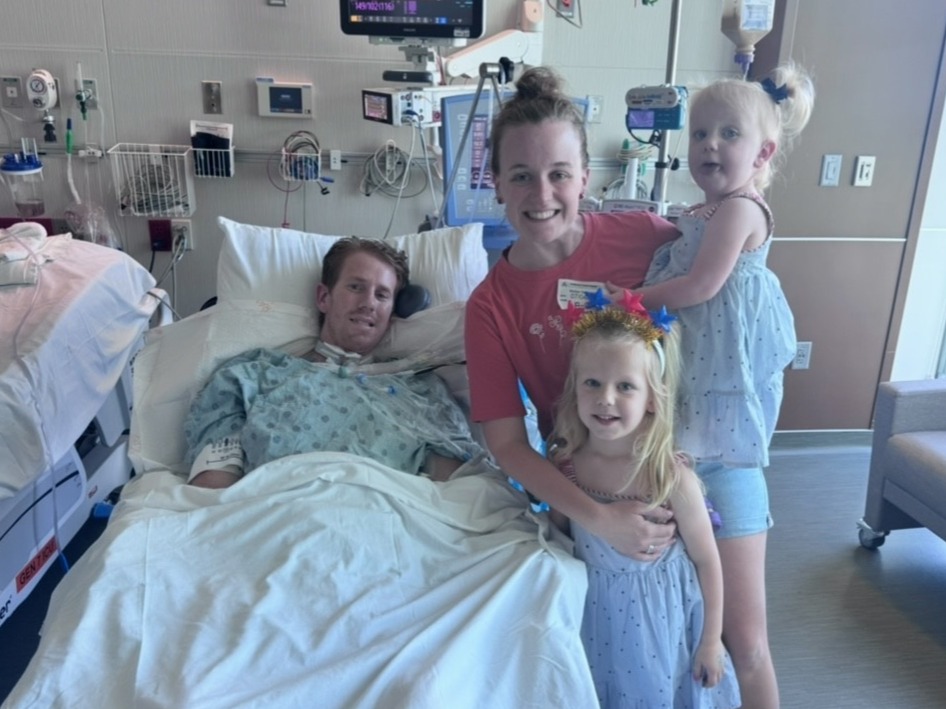
Paralyzed, Jake was unable to even blink. His prognosis was grim. For weeks, Jake’s wife, Katie, who is also a nurse, wasn’t sure if he was going to make it. She made the tough decision to allow Jake to receive a tracheostomy and feeding tube to increase his chance of survival.
Regaining Movement and Speech
Thankfully, Jake started to get better. Very slowly, the movement in his face started to come back. Before Jake could speak again, he and Katie created a system to communicate important words.
“We had an alphabet board that displayed all the letters. Katie would drag her finger across the letters and help me spell out a word. At first, all I could do was blink at the right letter,” explains Jake.
“It was such a process, but it was the only way we could know what he wanted,” says Katie. “We didn’t have time for full sentences, only words: Pain. Turn me. Things like that.”
Katie was consistently by Jake’s side. The hospital’s Child Life department helped Katie prepare their young girls to see their sick dad so they could often. Seeing his children was a huge motivator for Jake.
After six weeks at Toledo Hospital, Jake was transferred to a long-term acute care facility, where their main goal was to wean him off the ventilator. For a total of 53 days, Jake hadn’t been able to speak. Finally, his voice came back.
“That day, Katie and I had a four-hour conversation,” Jake says, laughing. “Speech is such a luxury.”
Jake’s Progress and Future Goals
Jake made fast progress, even though it felt slow to him. After long-term acute care, he had aggressive inpatient therapy. On July 31, 2024, his trach was removed, which allowed him to start speech therapy. A few weeks later, the feeding tube was removed. On Labor Day weekend, he was finally home.
Now, as of February 2025, Jake can walk with the help of braces. Unfortunately, nerve growth is slow, and he doesn’t know if his progress will continue or plateau.
“I’m currently doing outpatient therapy twice a week,” says Jake. “I still have numbness in my feet and my left hand is numb and painful. It’s a very painful condition.”
But Jake is working hard toward his next goal: driving again. He'd also love to go back to work in the same place he received his care.
The Magic of Multidisciplinary Care
“As one of the nurses in our neuro ICU, Jake was surrounded by colleagues and friends that were advocating for him every minute of every day,” says Dr. Swor. “As humbling as it must have been for him to be so sick and being taken care of by his colleagues, everyone was so engaged in his care and progress. Everyone rallied around him.”
Neuro ICU colleagues demonstrated their support for Jake with t-shirts, bracelets and a Go Fund Me to raise funds for his family.
“We received exceptional care. I trusted the neuro ICU team with everything,” Katie shares. “There was a month where we weren’t sure that Jake was going to survive. You could tell that it was hard on his colleagues, just like it was hard on our family.”
“The true magic of neurocritical care is dedicated and high functioning teamwork. This shaped Jake’s care and gave him the best chance for an eventual positive outcome,” says Dr. James. “We have a highly functioning team where everyone has their niche roles and works together to give patients the best opportunity for recovery.”
Dr. Swor adds, “His story is an example of how different disciplines throughout the hospital work together as well. There were times when experts in other specialties came together to help stabilize him and move him forward in his progress.”
Jake’s story has been impacted by the help of many people – from the emergency room to neuro ICU to rehabilitation. Of course, he and his wife are the foundation of this remarkable story. Jake’s persistence and Katie’s dedication have made his recovery possible.
“He’s blown a lot of people away with his progress,” says Katie. “He’s inspired so many people.”
Subscribe to Our ProMedica Newsletter
Looking for inspiration on how to improve your health and well-being? Get trustworthy health news, wellness tips and inspirational patient stories delivered to your inbox twice a month with our free ProMedica newsletter.