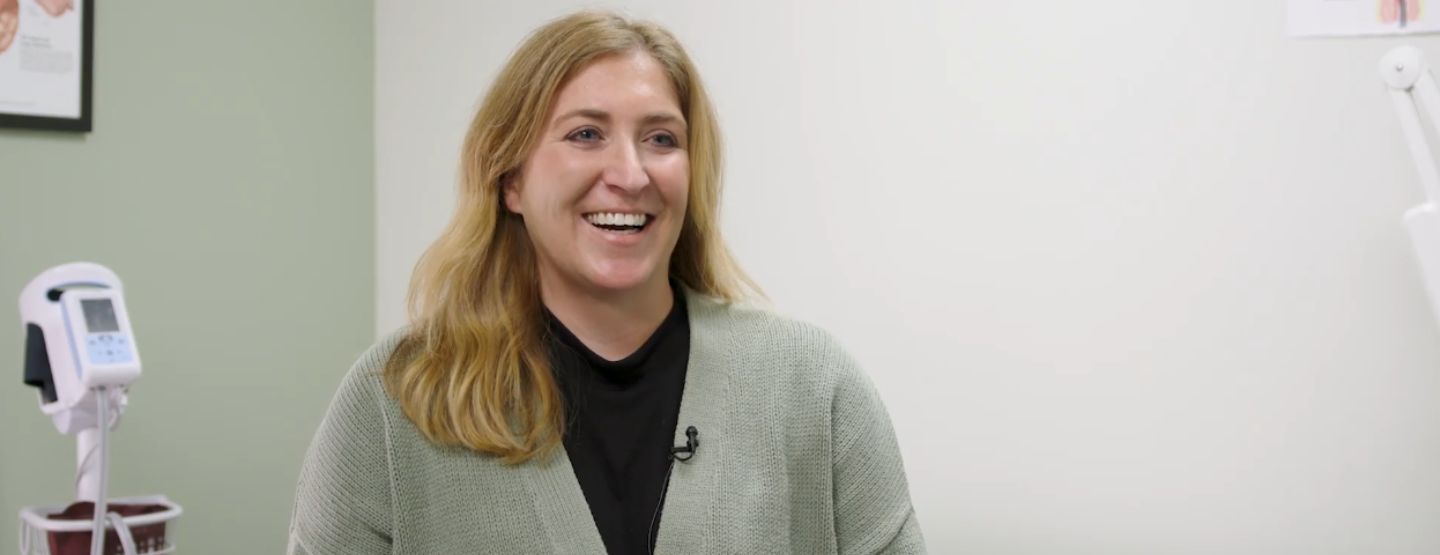
For the first time, colorectal cancer is the No. 1 cause of cancer-related death under the age of 50 in men. Eilynn Sipe, MD, with ProMedica Physicians Colorectal Surgery shares that she and other providers at her practice are seeing a significant increase in incidences of young people with colon cancer.
This makes following cancer screening guidelines for colorectal cancer even more important. Current guidelines from the American Cancer Society recommend that those with an average risk of colon cancer begin screening for colon cancer at age 45.
This is exactly how Stephanie Sharpe ended up undergoing her routine colonoscopy. When Stephanie turned 45, her primary care provider referred her to Dr. Sipe for the procedure. Within a week, Dr. Sipe’s office contacted her and got her colonoscopy on the schedule.
Colonoscopy Prep
Stephanie had heard horror stories of colonoscopy prep. But after experiencing it herself, she learned it wasn’t as bad as some people make it out to be. “Honestly, it wasn’t that bad. You hear people talking about the prep being the worst thing, but it’s really not. It lasts three hours if that, and then you’re done and ready for the colonoscopy,” Stephanie shares.
Stephanie then showed up first thing the next morning for her procedure, a bit hungry and ready to get the colonoscopy over with.
Post-Colonoscopy
Stephanie describes waking up feeling like she had a really nice nap, and thankful that she had the colonoscopy done after she found out that two large polyps were removed during the colonoscopy.
When polyps are discovered during a colonoscopy, they are removed and analyzed by a pathologist. The results then come back as hyperplastic (not precancerous) or adenomatous (pre-cancerous).
Both of Stephanie’s polyps came back as adenomatous, or precancerous. This means that while they were not cancer at the time that they were removed, they likely would have turned into cancer had she waited.
“It was a blessing that I had the colonoscopy done when I did. I feel like if I would have waited, maybe even a year, they could have turned cancerous,” Stephanie shares. “Cancer is scary. I was very thankful and relieved that we caught it before it became cancer.”
“By Stephanie coming in for her routine colonoscopy, she can skip or prevent herself from ever having colon cancer. If she had waited until age 50 or longer to get a colonoscopy, she could have had colon cancer,” Dr. Sipe shares.
Colonoscopy Follow Up
Because her polyps were so large, which puts her at a higher risk for colon cancer, Stephanie will have another colonoscopy one year from the time of her first colonoscopy, and then as long as nothing new is discovered, every five years after that.
If you are at an average risk for colon cancer, meaning that you don’t have a family history and no polyps are discovered during your colonoscopy, your provider will likely recommend you receive a colonoscopy every 10 years.
Schedule the Appointment
Stephanie reassures that there is no reason to fear a colonoscopy. “It’s a great method to catch anything that could be happening that you’re not aware of yet.”
The biggest advantage of a colonoscopy is that the provider can go in and look for polyps. Those polyps can grow and turn into cancer, but by removing them, colon cancer can be prevented.
If you’re 45, have a high risk of colon cancer or are experiencing symptoms, talk to your primary care provider to see if a colonoscopy is right for you.
“There’s a certain amount of stigma related to colonoscopies. But I cannot emphasize enough the importance of getting the test done because it makes a huge difference,” Dr. Sipe shares.
Eilynn Sipe, MD
Dr. Sipe is a colon and rectal surgeon with ProMedica Physicians. View her profile.
Subscribe to Our ProMedica Newsletter
Looking for inspiration on how to improve your health and well-being? Get trustworthy health news, wellness tips and inspirational patient stories delivered to your inbox twice a month with our free ProMedica newsletter.