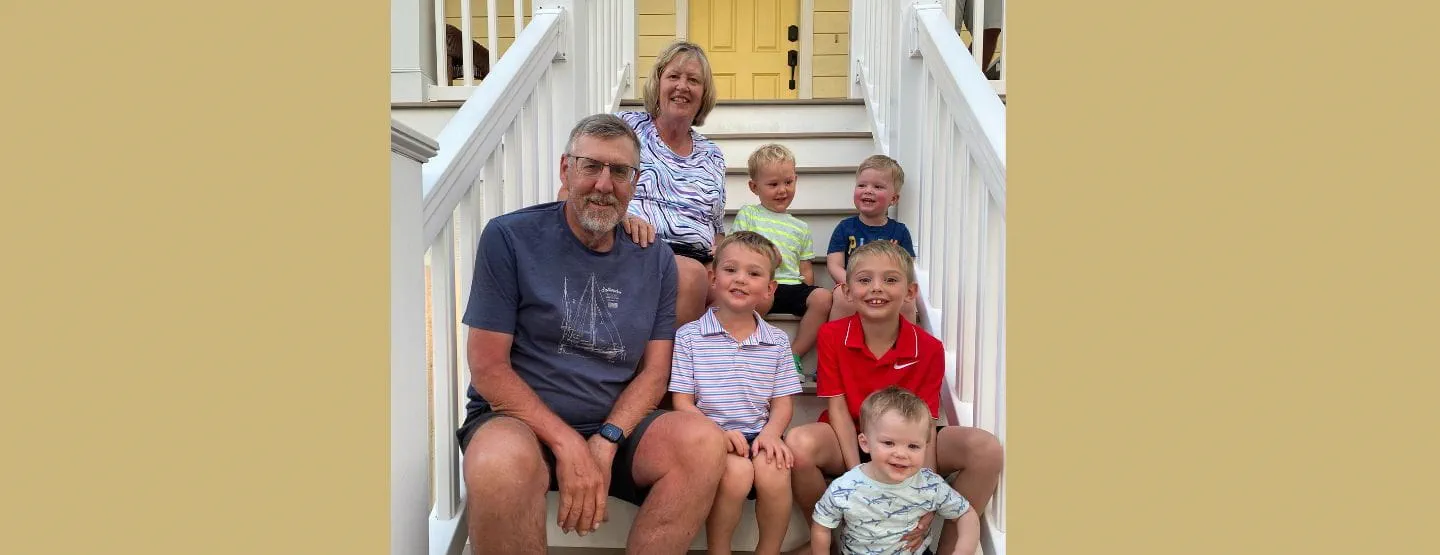
Roy Brandes was about to leave for vacation when he received a call to go to the emergency room immediately. His doctor had just received his test results, which showed he had a very high risk for blood clots.
He didn’t know it then, but his heart was failing and he would need open heart surgery. He would also be the first patient in the Toledo region to have planned use of a newer device that would save his heart.
Heart Failure Due to a Leaky Heart Valve
Living in Hillsdale, Michigan, Roy was sent to ProMedica Toledo Hospital in April 2023.“They told me shortly after doing some tests that my heart was functioning at about 15-20%,” says Roy. “That’s when I met Dr. Moront and Dr. Hariri. Those two guys are my heroes.”
Michael Moront, MD, and Imad Hariri, MD, are two specialists who led Roy’s care team. Dr. Moront, a cardiothoracic surgeon, and Dr. Hariri, a cardiologist and advanced heart failure specialist, worked together to determine the best course of treatment for Roy.
“Roy had severe swelling due to improper blood flow,” explains Dr. Moront. “We used aggressive diuresis, including IV diuretics and water pills to reduce the swelling. We were able to take about 40 pounds of water weight off him.”
“He came in with symptoms of heart failure and was found to have severe valve leakage that we thought may have been due to an old, healed vegetation,” adds Dr. Hariri. “These are growths on the valve that can happen from infection. They impede the function of the valve, which can lead to valve leakage because it can’t shut all the way.”
Roy’s valve leak had caused his heart to weaken severely and ultimately led to a heart rhythm abnormality, called atrial fibrillation (Afib). This had caused a drop in blood pressure and severe heart failure symptoms over the last few months. It explains why Roy had been feeling so tired, yet felt like his heart was racing.
“They were bound and determined to find out exactly what was going on and what to do about it,” says Roy.
Heart Pump Helps Roy’s Heart Rest During Surgery
Open heart surgery was needed to replace one of Roy’s valves and repair another. Thankfully, Dr. Moront believed Roy was the perfect candidate for a special device that would help his weak heart through it.
During surgery, a heart pump was placed in Roy’s heart, with one part in the left ventricle of the heart and the other in the aorta.
“This heart pump brings blood out of the left ventricle and into the aorta, where it can be put into systemic circulation throughout the body,” explains Dr. Moront. “This reduces the work of the heart so it can recover after a procedure. It also decompresses the heart, so the patient can have plenty of blood flow without the heart itself becoming too full.”
While heart pumps are not new, this particular one isn’t yet widely used and is surgically implanted. This special device is able to give the body 5.5 liters of blood output that the heart would normally be able to generate. This gives the body full cardiac support.
Roy’s case was the first planned use of this special heart pump in the Toledo region.
“With this heart pump, we now have a tool with the capacity to totally support a patient’s circulation and allow their heart to recover after surgery or heart attack. That’s a game changer,” says Dr. Moront. “With better circulation, a patient is less likely to experience cardiogenic shock after surgery, and has a better chance of mobility right after surgery, which is critical. Patients can be out of bed and walking much sooner.”
Without this particular heart pump, Roy may have faced cardiogenic shock, which is when the heart can’t pump enough to meet the body’s needs. But with this device and his care team, Roy’s surgery was a success.
“I came out of surgery and was obviously hit hard by post-op, but I was alive. I remember later that day waking up and thinking, ‘Thank God for these people,’” Roy shares. “It still makes me emotional because they gave me a second chance. I feel as good now as I have in 15 years. I give Dr. Moront and Dr. Hariri all the credit in the world.”
A Multidisciplinary Team for an Individual Approach
Roy’s case was a complicated one, and an example of how multidisciplinary teamwork can lead to a successful patient-centered care plan.
“ProMedica is the only one in the city with a multidisciplinary cardiogenic shock initiative. It’s usually comprised of cardiologists, intensive care doctors, cardiothoracic surgeons and others,” explains Dr. Hariri. “It allows us to make a call or meeting and discuss patient care. Then we can come up with the best solution for the patient using a multidisciplinary approach that takes into account the care of the patient from the point of view of multiple specialists.”
A team approach led Roy throughout his journey, from diagnosis to surgery to recovery. Even before his heart surgery, Roy’s care team worked together to tackle another issue – his oral health.
“I had a couple of teeth that were broken and exposed to the root,” says Roy. “The doctors pretty quickly identified that that was an issue that had to be fixed before surgery.”
Poor oral health can lead to poor heart health. In fact, it’s likely that the healed vegetation in Roy’s heart valve, which led to a leaky valve, was due to a prior infection that started in his teeth.
Dr. Hariri explains: “Bacteria in your mouth cavity can enter the blood stream when the gum is not healthy or injured like after dental work. Usually, that kind of bacteria likes to stick on heart valves and develops endocarditis, an infection of the heart valves and tissue of the heart.”
Because Roy’s heart condition was so severe, his care team arranged for an oral surgeon to treat him at Toledo Hospital. Once his dental health was in check, the team helped him through surgery and recovery.
On the Road to Better Heart Health
Roy was a prime candidate for the special heart pump because there was a visible path toward his recovery. After surgery, Roy used the heart pump for a few days, and was slowly weaned from the device as his heart was continuously monitored. Then, it was removed with a small surgical procedure done at bedside.
Having highly specialized experts involved in Roy’s care has helped him achieve more than he thought he could after surgery. Of course, Roy has been an important part of the team, too. He’s quit tobacco and alcohol, and is getting exercise. He also continues with rehabilitation.
“Those who have been through open-heart surgery can tell you, it takes time for your body to recover,” says Roy. “But my health trend has been more than I ever could have expected. By August 2023, I was back on the golf course because I felt great. I can’t say enough good things about what this team has accomplished.”
Subscribe to Our ProMedica Newsletter
Looking for inspiration on how to improve your health and well-being? Get trustworthy health news, wellness tips and inspirational patient stories delivered to your inbox twice a month with our free ProMedica newsletter.