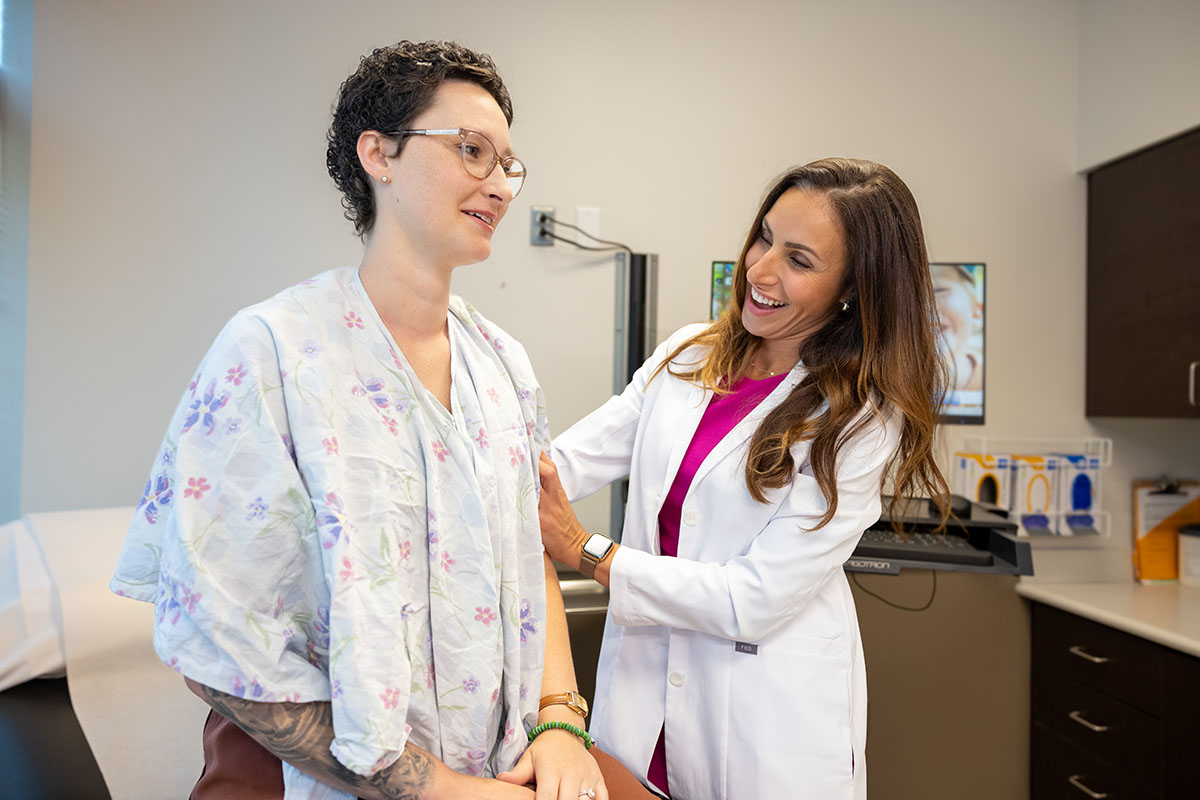
Ten months after giving birth to her daughter, Taylor Caryl was diagnosed with breast cancer. Shocked and devastated, the 25-year-old began a long journey of cancer treatment. About a year later, just when she thought she was cancer-free, she found a new lump on the skin near her reconstructed breast.
What started as a hormone receptor-positive cancer had recurred as triple negative breast cancer (TNBC). With a new diagnosis and course of treatment, Taylor has found strength in her husband and daughter, as well as her second family – her cancer care team.
A Postpartum Breast Cancer Diagnosis
In September 2025, Taylor developed mastitis for the third time. Mastitis, an inflammation of the breast tissue, is common among breastfeeding women. However, the frequent occurrences and a persistent breast lump meant she needed a breast biopsy. The test results showed that it was cancer.
“I was devastated hearing that six letter word — cancer — when I was just getting comfortable in motherhood,” says Taylor.
She began her journey of breast cancer treatment, which included chemotherapy, radiation therapy, hormone therapy, a double mastectomy to remove breast tissue, a partial lymph node dissection, and partial reconstruction to reshape the breasts.
After a year of treatment, Taylor and her care team thought she might be cancer-free. But another lump, which they hoped was scar tissue, turned out to be cancerous. Just three days before hitting the one-year mark of her (hormone receptor-positive) breast cancer diagnosis, she was diagnosed with a different type of cancer: triple negative breast cancer (TNBC).
How Triple Negative Breast Cancer Changes Treatment
The recurrence of Taylor’s cancer as TNBC is a phenomenon called receptor conversion. It can happen after a person is treated with endocrine (hormone) therapy or cytotoxic chemotherapy, which kills rapidly dividing cells. A TNBC diagnosis changed Taylor’s treatment options.
Her breast surgeon, Jessica Burns, MD, with ProMedica Physicians Surgical Oncology explains, “Triple negative breast cancer has the potential to behave very differently from hormone receptor positive breast cancers. It is much more likely to spread to other areas of the body.”
Because of TNBC’s potential to spread, Taylor switched to systemic therapy (e.g., chemotherapy) to reach cancer cells wherever they are in her body.
Dr. Burns says that genetic testing is also especially important in patients with TNBC, as the mutation of certain genes can influence the drug choices used for treatment.
Since her TNBC diagnosis, Taylor has had two hormone positive invasive ductal carcinoma diagnoses. This means that the cancer cells originated in milk ducts. She has had additional surgeries to remove tumors and lesions, and takes oral chemotherapy to prevent cancer from spreading.
Working with a Multidisciplinary Care Team
With such a complex case of cancer, Taylor works closely with her care team, which she describes as her second family.
“My care team has made me feel like I have a secondary family that I can rely on,” Taylor says. “They are working hard behind the curtain and advocating for me the way that I would hope a family member would advocate for me if I couldn’t be in the room.”
Taylor says every member of her care team has shaped her experience in her cancer journey. Dr. Burns makes her feel heard and seen every step of the way. Her medical oncologist, David Macari, MD, ensures she’s getting top-notch care. Her radiation oncologist, Eric Kielhorn, MD, is kind and eager to hear her feedback. The nurses at the infusion center are attentive and considerate.
This collaborative approach has positively impacted Taylor and her treatment. “I would describe my care team as proactive and aggressive,” she says. “As soon as something’s happening, they’re on top of it, making sure I get the best care possible.”
“Teamwork and collaboration are critical for treating cancer patients,” says Dr. Burns. “Breast cancer care is constantly evolving, and we all work hard to keep up not only on advances and best practices in our own discipline, but also those of our colleagues.”
Compassionate, Patient-Centered Care
ProMedica Cancer Institute treats more patients than any other cancer care group in the region. And every one of those patients is an individual with a unique journey.
“Every single patient and every single diagnosis is different,” says Dr. Burns. “We must be empathetic to every patient’s unique situation to ensure that we are treating the whole person in front of us, not just a disease on a pathology report or a finding on a CT scan.”
This patient-centered approach means learning about the patient as a person, what their support network looks like, what their biggest fears are surrounding their diagnosis and treatment, and understanding how the care team can best support them as they navigate their diagnosis.
More than anyone, Taylor knows the vital role a patient has in their own healthcare. Her advice for another cancer patient would be to listen to your body and to trust your instincts.
“You know your body so much better than anyone,” says Taylor “Take your care team’s advice for what it’s worth but follow your gut. Please advocate for yourself.”
Advanced Cancer Treatment and Technologies
Advancements in breast cancer care give patients like Taylor more treatment options and greater hope for a healthier future.
Some of these advancements include access to clinical trials, targeted radiation therapy and leading-edge surgical techniques. Dr. Burns, for example, is a fellowship-trained surgeon in breast oncology. She specializes in nipple-sparing mastectomy and breast cancer surgery that protects healthy breast tissue. These options help patients like Taylor feel more like themselves after life-changing procedures.
Dr. Burns and her colleagues stay on top of advancements in the field through medical societies, medical journals and national meetings. Then, they bring innovative solutions back home to their patients.
“For us as surgeons, we have the privilege of being the recipient of what some would consider the ultimate demonstration of trust in healthcare. That is something we take very seriously in every single case, every single day,” says Dr. Burns.
That trust makes all the difference to patients like Taylor. She says, “Having my care team hold my hand through and support me every step of the way was the best thing I could have asked for.”
What’s Next for Taylor
Living with breast cancer has shown Taylor her immense strength. She has seen her own resilience and determination to get through her treatment and to balance it with being a mother and a wife.
The experience has given her a perspective that most moms don’t have. One that takes each moment as it comes.
“Being a young mom with cancer is world-changing,” Taylor says. “Every single tiny milestone my daughter has — saying a word correctly, running as fast as she can — I am very grateful that I get to experience them with her.”