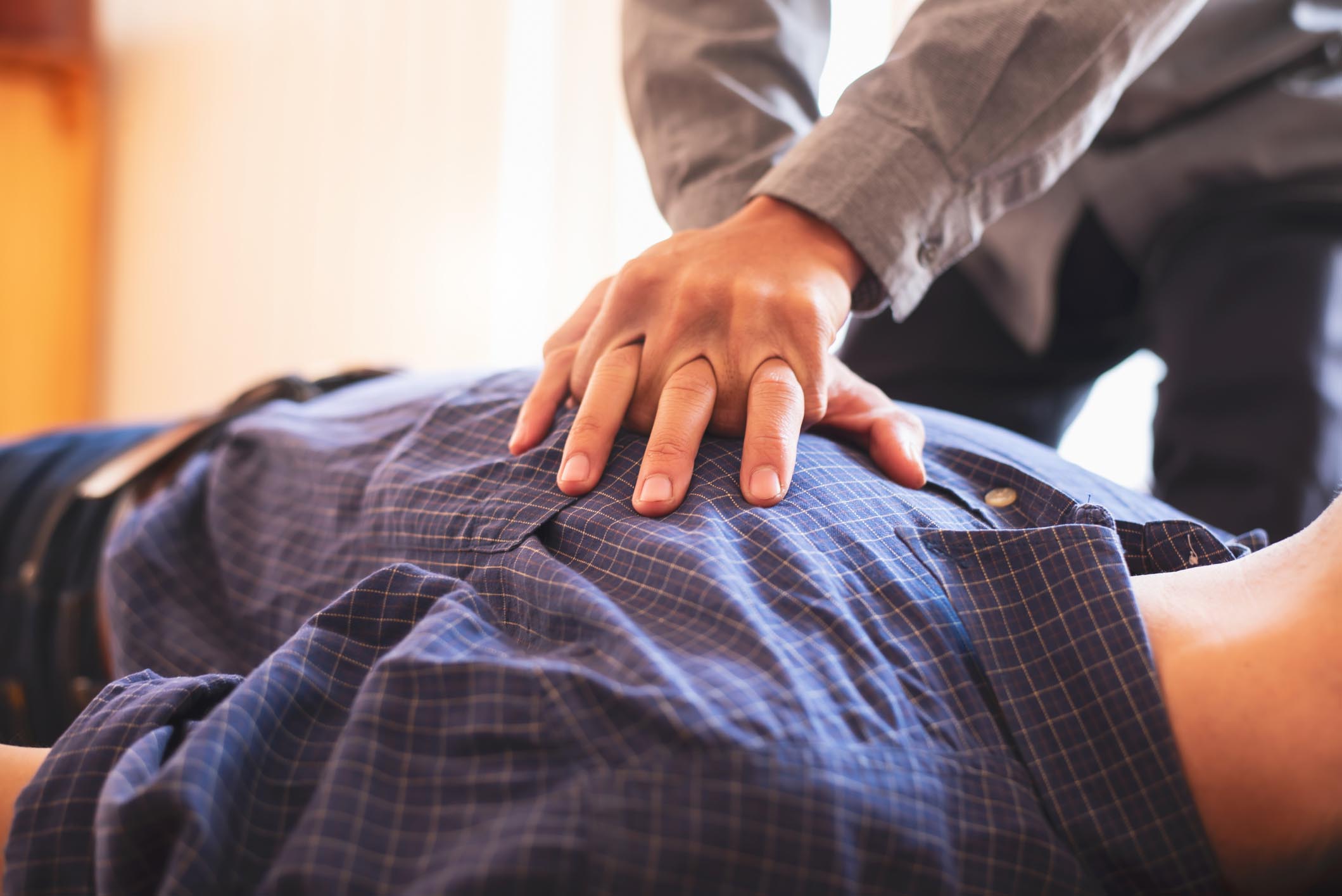
When seconds count, Hands-Only CPR can help save a life. When cardiac arrest occurs, the heart immediately stops pumping. The body becomes deprived of oxygen-rich blood, putting the heart and brain function in jeopardy. The Hands-Only CPR technique helps keep blood flowing. It sustains heart and brain function until first responders arrive to administer more sophisticated measures.
Why should I learn CPR?
According to the American Heart Association (AHA), about 90% of people who suffer out-of-hospital cardiac arrests die. You have the power to double or triple a cardiac arrest victim’s chance of survival by performing Hands-Only CPR.
While administering Hands-Only CPR may seem scary, you can become more comfortable by taking the time to learn about and practice the procedure. In most states, you are protected by the Good Samaritan Law for any damage caused while performing Hands-Only CPR or using an automated external defibrillator (AED), so long as you are acting in the best interest of the victim.
“Performing CPR is always worth it. You may save someone’s life, who without CPR wouldn’t survive,” shares Kelli Monahan, training center coordinator with ProMedica CPR Rescue Training Center.
What should I do if I witness cardiac arrest?
If you see a teen or adult collapse, call 911 immediately. If you aren’t sure what to do from there, the 911 operator can walk you through the steps to perform CPR. If you are in public, ask other bystanders to try to locate an AED. An AED will deliver a shock to the heart to try to restore its natural rhythm. An AED will provide instructors, but the 911 operator can instruct you on how to use this as well.
How do I perform CPR?
CPR can be performed in a hands-only or conventional (breath-giving) method. Hands-Only CPR is performed by pushing hard and fast in the center of the chest at 100 to 120 beats per minute. That’s around the same tempo as “Stayin’ Alive” by the Bee Gees, “Call Me Maybe” by Carly Rae Jepsen and “Ring of Fire” by Johnny Cash. Check out the AHA’s Don’t Drop the Beat playlist for more song options.
According to the AHA, hands-only CPR can be just as effective as conventional CPR in the first few minutes after cardiac arrest.
“Chest compressions alone make a huge difference in a person’s odds of survival,” shares Monahan. “Hands-Only CPR can be lifesaving, and done even if someone is not comfortable with giving breaths.”
Here are five steps to help if you can administer lifesaving assistance:
1. Check the patient's responsiveness. Shake the unresponsive person by the shoulders and speak loudly to rouse them.
2. Check their breathing and pulse. Can you see their chest rising and falling indicating that they are breathing and exchanging oxygen? Can you find a pulse in their neck? If not, the person is likely in need of CPR.
3. Call 911. Operators are trained to provide coaching over the phone and can talk you through the steps for giving CPR until emergency medical technicians arrive.
4. Administer chest compressions. Place hands in the center of the chest and begin compressions, hard and fast, at a rate of 100 to 120 beats per minute.
5. Recheck breathing and pulse. Is the person breathing independently again or is a pulse detectable in the carotid artery? If so, stop compressions. If not, continue compressions until emergency responders arrive. Giving chest compressions can be hard to do for a long time. If necessary, engage other bystanders in providing assistance by calling 911 and taking turns administering CPR.
How do I become CPR-certified
Anyone can become CPR-certified, and by doing so, you just might save a life. CPR courses provide hands-on CPR training. You’ll learn the proper way to provide Hands-Only CPR and conventional (breath-giving) CPR. You’ll also learn how to use an AED.
Visit the AHA’s website to find a CPR certification course near you.
Subscribe to Our ProMedica Newsletter
Looking for inspiration on how to improve your health and well-being? Get trustworthy health news, wellness tips and inspirational patient stories delivered to your inbox twice a month with our free ProMedica newsletter.