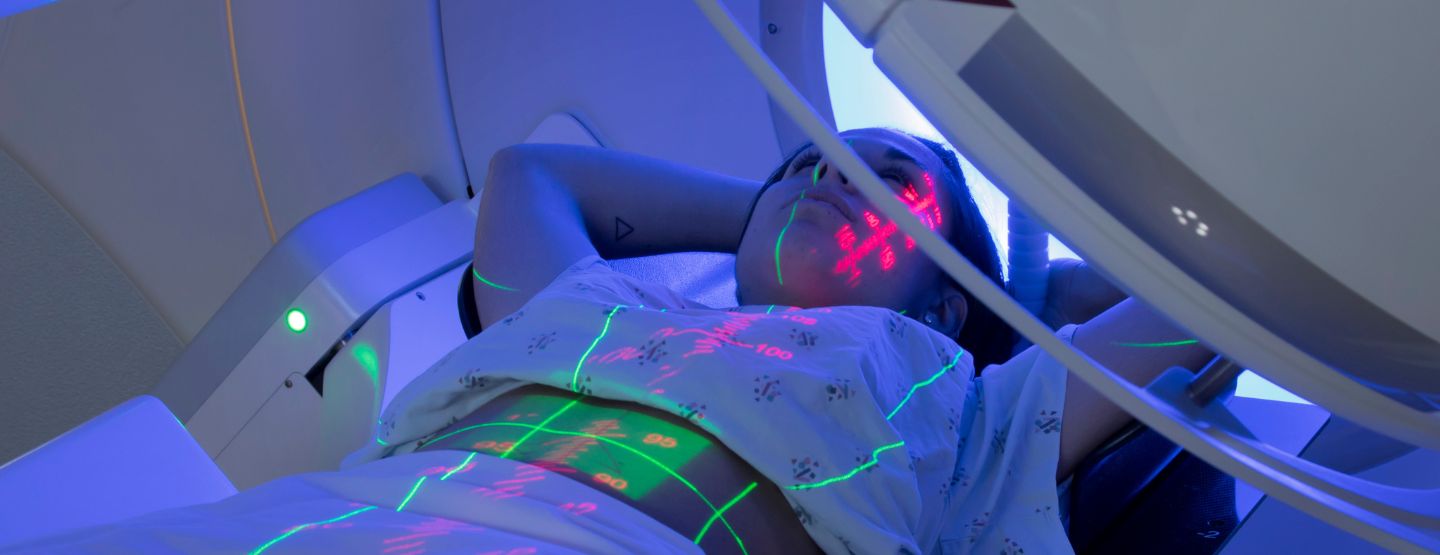
Radiation therapy is a common form of cancer treatment. It uses high-energy beams to kill cancer cells, stopping them from growing or spreading. In most cases, radiation therapy can destroy a tumor completely.
State-of-the-art radiation treatment in smaller communities makes it easier for patients to get exceptional cancer care close to home. For patients like Betty Braden, close care can make a huge difference.
Eighty-year-old Betty is a resident of Monroe, Michigan. She’s able to drive a longer distance for care if needed, but when combined with cancer treatment, the drives are draining. She also has POEMS syndrome, a rare blood disorder that can cause tumors, sometimes cancerous, to grow throughout the body.
Betty recently completed radiation therapy at ProMedica Monroe Cancer Center, a Department of ProMedica Monroe Regional Hospital. The goal of the therapy was to treat three tumors on different parts of the body. She chose to come back to the cancer center where she had previously received treatment.
“I was very happy with the radiation therapy I received there on my nose last summer for basal cell cancer,” Betty says. “The way the team treats you is so nice, you’re just at ease. I couldn’t ask for better people to treat me.”
Radiation that Targets the Tumor
In radiation therapy, precision is everything. Making sure to treat the tumor – and only the tumor – with the electron beams is vital. It makes the treatment more effective and reduces side effects of the treatment.
The TrueBeam® Linear Accelerator used at Monroe Cancer Center was updated in September 2025. With every update, there are enhanced features that make the experience better for cancer patients and the care team. For instance, the imaging tools are a little clearer.
Roger Kucway, MD, a radiation oncologist explains, “There is a little sharper contrast between the tumor and the normal structures. This is helpful for certain locations. It decreases the risk of side effects to healthy structures around the tumor.”
Dr. Kucway treated Betty both in the summer of 2024 and again in 2025. He says the machine also allows for a precise dosage of radiation throughout treatment.
“We can produce a plan delivered by the machine to provide a more uniform dose of radiation. It also has a smoother dose curve within the tumor volume,” he says. “It has sharp edges and can decrease the dose quickly to spare normal, healthy tissue.”
For example, patients receiving radiation therapy for prostate cancer can experience bladder or rectal irritation. But advancements in radiation therapy are reducing the risk of damaging surrounding healthy cells.
Improvements in Patient Comfort
Radiation therapy can be uncomfortable for patients, who must stay still during treatment.
“I had to lay on my stomach, which was uncomfortable, but they try to make it as comfortable as possible,” says Betty. “Once they get you set up, the treatment isn’t that long.”
Therapy treatments are about 10 to 15 minutes long. Most of that time is spent getting the patient in the correct position and setting up the machine. The beams themselves are only on for about 30 to 40 seconds at a time.
Before radiation therapy begins, patients have a simulation appointment. It’s like a dry run to set up everything and prepare for therapy treatments. During the simulation, patients are marked with small, permanent tattoos to identify treatment areas during radiation therapy.
“Our goal is to get away from using those tattoos,” says Dr. Kucway. “We’re moving toward using surface guidance radiotherapy, or SGRT. The software produces an image of the external surface to keep the patient in proper alignment. With that technology, we don’t have to rely on the tattoos.”
The use of SGRT is in a trial phase throughout ProMedica Cancer Institute radiation therapy locations. The results of SGRT are promising. The setup is proving to be a little faster and help decrease the patient’s time on the therapy table. It also means patients won’t need to be marked with small, yet permanent, dots.
The new software also helps monitor patient movement during radiation therapy. If a patient moves too much, the system alerts the team so they can pause and reposition the patient. This keeps the treatment accurate and safe.
However, the treatment table itself has also been upgraded to easily adjust positioning. “Instead of moving the patient, we can just adjust the table in more directions to better position them,” Dr. Kucway explains.
Consistent Care throughout Cancer Centers
Committing to the latest technology for radiation therapy is part of ensuring that all patients have access to the same advanced treatments, no matter where they live.
“The linear accelerator at Monroe Cancer Center is the same as the one used at Hickman Cancer Center at ProMedica Flower Hospital,” says Dr. Kucway. “That allows us to offer more treatments in our local community for various cancers like brain cancer and pancreatic cancer.”
Using the same machine also provides consistent experiences for patients who may need to be transferred to another hospital.
“If there were an instance where a patient from Monroe had to go to Flower Hospital, the data from our machine can be transferred to that location,” explains Dr. Kucway. “It’s efficient and decreases the risk of potential errors from manual setup.”
Over the years, Betty has received cancer care at various ProMedica locations, including Flower Hospital and ProMedica Charles and Virginia Hickman Hospital. She’s been happy with her care but is grateful to stay close to home. And she’s confident in her local care team.
“These doctors are constantly studying; it’s not a one-time education for them,” she says. “They are keeping up with new ways of treating cancer.”
Radiation therapy has its challenges for every patient. While Betty had no pain throughout her radiation therapy, she had burning sensations on her skin when the treatment ended. It’s a common side effect of radiation therapy and her care team gave her instructions to help with healing.
But Betty is as strong as they come. She’s been facing cancer since she was diagnosed with breast cancer in 1999.
“People know that you can die from cancer, but you can also live with cancer,” she says. “Don’t let yourself get depressed through it all. Do something to make yourself feel better. You can let things get you down, or you can try to find good in it all.”
Roger Kucway, MD, is a board-certified radiation oncologist who is part of the ProMedica Physicians Radiation Oncology team. He believes in a multidisciplinary approach that includes education and emotional support in a warm, healing environment. View his profile.
Subscribe to Our ProMedica Newsletter
Looking for inspiration on how to improve your health and well-being? Get trustworthy health news, wellness tips and inspirational patient stories delivered to your inbox twice a month with our free ProMedica newsletter.