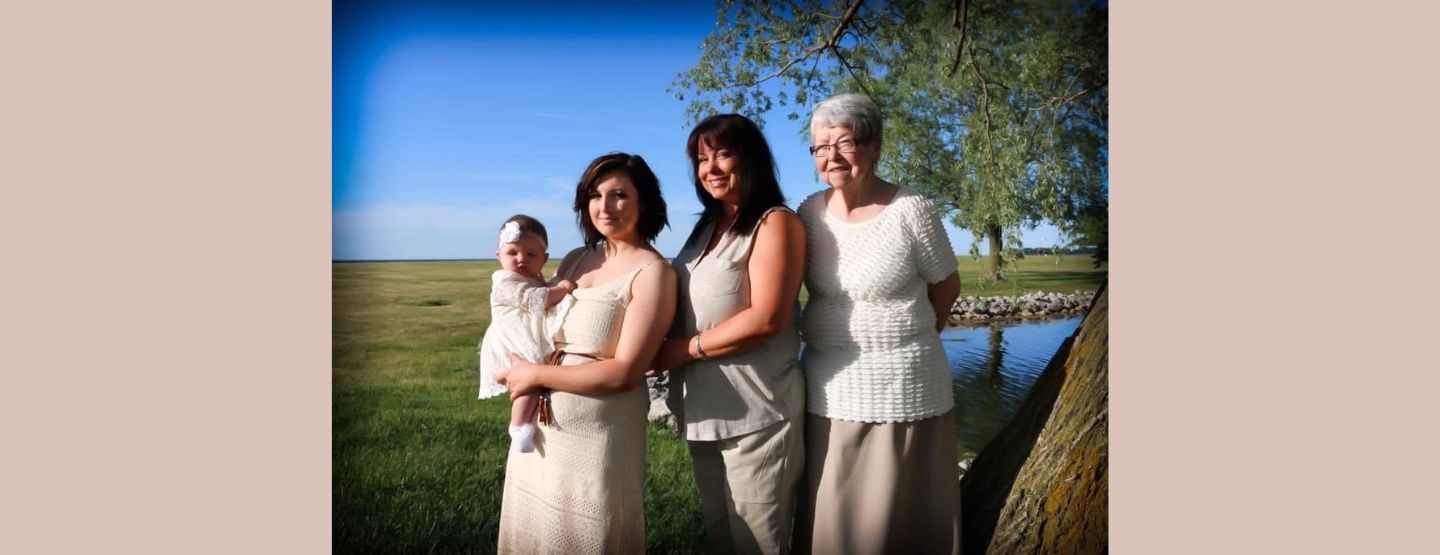
Alyson Stanton, RN, could say that being a nurse is in her blood. In 2022, when she graduated nursing school, her graduation cap donned photos of her, her mother and her grandmother with letters that read: 3RD GEN RN.
“I had always said I didn’t want to be a nurse, from hearing all of the stories from my mom growing up,” says Alyson.
But around 2017, that changed. Her grandmother was diagnosed with pancreatic cancer and she helped her mother take care of her. “The feeling I got from that experience really changed my view of nurses and being able to take care of people,” she explains.
So right after finishing cosmetology school, she jumped into nursing school to follow in the footsteps of her mother and grandmother.
Being Part of the Toledo Hospital Family
Now, Alyson is the only one out of 13 grandchildren continuing the family legacy of nursing. She works at ProMedica Toledo Hospital in the neurology unit.
“I love working at Toledo Hospital because I feel a good sense of support among coworkers and managers. The first year as a nurse is so challenging but there was so much help available for me. The nurse residency was an amazing way to slowly get into what I was doing,” says Alyson.
Alyson’s mom, Cindy Lau, RN, was a little apprehensive about her daughter becoming a nurse. “I didn’t want her to have to go through the stresses of being a nurse,” says Cindy. “But she’s really smart and has the tenacity nursing requires. Being a nurse requires having the right balance of compassion and firmness.”
Cindy graduated from nursing school in 2008 and has worked at Toledo Hospital for a total of 22 years. “I was here before Renaissance Tower and Generations Tower, back when you had to decipher doctors’ handwriting,” she says, laughing.
Cindy’s mother had hesitations about her career path, too. Her mother, Jan Anaple, was the charge nurse (unit manager) in the Coronary Care ICU at Riverside Hospital.
“Growing up watching my mom, I thought it was so cool that she was a nurse. She seemed to be superwoman, being the charge nurse, raising seven kids, cooking every night,” says Cindy. “Besides having my mom as a role model, I always had an interest in science. I had a teacher in high school tell me I should become a nurse. But when I expressed interest in being a nurse, my mom told me not to do it.”
One out of seven children, Cindy was the only one to become a nurse. She now works at Toledo Hospital in blood management.
“Toledo Hospital has given me a lot of experiences. I’ve been a patient, a visitor, a unit clerk, a nursing assistant and a nurse. I had my first baby here. My first grandbaby here. I met my husband here and he still works here,” she says. “I’ve made a lot of connections with coworkers who have supported me through tough times and coworkers who I’ve supported in tough times.”
Witnessing Advancements in Hospital Care
In her years at Toledo Hospital, Cindy has witnessed many advancements in care. In 2009, an ECMO machine was brought to the hospital to help a pregnant woman infected with H1N1 or “swine flu”.
“Even there weren’t many H1N1 cases, we did get a few patients who got really sick and developed acute respiratory distress syndrome (ARDS),” explains Cindy. “It was difficult to adequately ventilate their lungs. The ECMO machine helped perform the work of the lungs so that the patient’s lungs could rest.”
Cindy also remembers Dr. Fernando Arias, a maternal-fetal medicine specialist who helped patients with high-risk pregnancy and delivery. She recalls him performing fetal surgery, which meant the operation was done in utero. Robotic surgery with the da Vinci surgical system, hyperbaric medicine and therapeutic hypothermia for heart attack patients are other treatment advances that Cindy has seen.
Working in blood management and the bloodless care department, Cindy is currently part of medical advancement, helping patients avoid an unnecessary blood transfusion. “The bloodless care department, for patients who decline a blood transfusion, is unique. We’re one of less than 125 hospitals throughout the United States. Because of this department, we’re seeing improved outcomes, like reduction in length of stay and a lowered risk of morbidity and mortality,” explains Cindy.
Appreciating the New and the Familiar
For daughter Alyson, the advancements in care can be seen in the building itself. “The biggest thing that stands out to me was when they built Generations Tower. It’s almost a simple design, but so intricate. Everything is so easily accessible, and the building is beautiful, too.”
The tower, which opened in 2019, was built to improve the patient experience with greater privacy and hotel-like amenities. The space was also designed for better care team collaboration and innovation, with shorter walking distances and easy-to-access medicine and supplies.
“It’s so cool to see the changes in the hospital over time,” says Alyson. But she appreciates the familiar places in the hospital as well.
“My mom worked in the postpartum floor in the old hospital building, and I remember visiting her when I was younger. When I worked as a hospital aide at the start of the COVID-19 pandemic, they offered to let us shower on that floor. I got so emotional being back on that floor, where my mom worked and where I had my daughter.”
Subscribe to Our ProMedica Newsletter
Looking for inspiration on how to improve your health and well-being? Get trustworthy health news, wellness tips and inspirational patient stories delivered to your inbox twice a month with our free ProMedica newsletter.