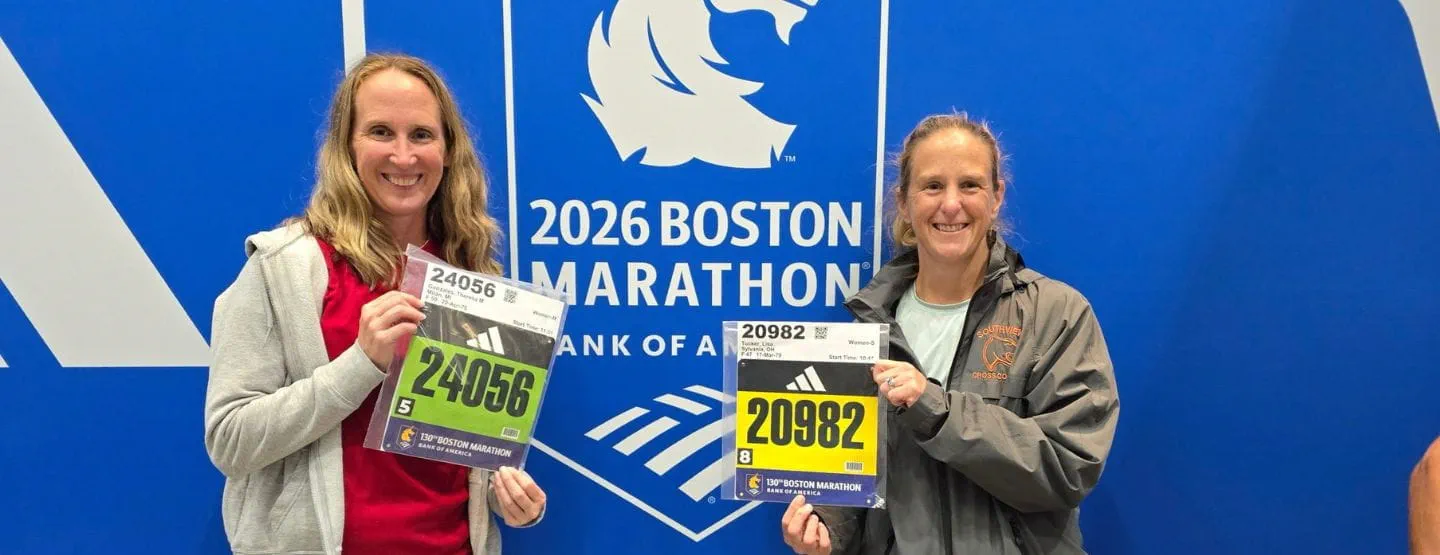
While training for the upcoming Boston Marathon, Lisa Tucker had an unexpected injury. Her Achilles tendon was so badly injured that surgery was possible.
With her marathon goal in mind, Lisa saw Roger Kruse, MD, a ProMedica physician specializing in regenerative and sports medicine. He offered an alternative treatment plan: platelet-rich-plasma (PRP) therapy and focused rehabilitation.
It turned out to be the exact treatment Lisa needed to make it to Boston.
From Achilles Injury to PRP Therapy
Lisa first ran the Boston Marathon in 2017 — one of the hottest races of the decade. She felt like she had trained so hard for an experience that didn’t turn out the way she had hoped.
She began training for the 2026 Boston Marathon. This time, she would run it with her sister, who would celebrate her 50th birthday the day of the race.
Then, Lisa severely injured her Achilles tendon, which connects the calf muscles to the heel bone. At first, it began with tightness, soreness and a little bit of swelling. But the symptoms continued to worsen. When she saw Dr. Kruse in October 2025, her Achilles was swollen to the size of a tennis ball
"I knew it was getting bad when the swelling never went down. I couldn’t get my foot in my shoe,” explains Lisa. “There were mornings I would wake up and I could not bear any weight on it. Some days I couldn’t run at all.”
Knowing Lisa’s goal to run the marathon, Dr. Kruse recommended PRP therapy. With disciplined rehabilitation, the therapy would help Lisa get back to her training as soon as possible.
“I’ve seen great responses to Achilles tendon injuries with PRP therapy,” says Dr. Kruse. “I typically expect patients to feel a lot better afterward.”
Lisa’s severe Achilles injury and her marathon goal presented challenges, but Dr. Kruse was confident.
How Platelet-Rich Plasma Therapy Works
PRP therapy uses a person’s own concentrated blood to promote healing. First, blood is taken from the patient. Then, the sample is spun in a lab at Dr. Kruse’s office to separate the platelets in the blood cells.
“This concentrates the platelets in the blood so that the result is plasma with a higher platelet count,” explains Dr. Kruse. “When this PRP-rich blood is injected into the injured area, it stimulates natural wound healing. We use ultrasound during therapy to ensure the injection site is precise.”
Platelets are the part of your blood that helps it clot. Platelet-rich plasma has regenerative cells, which are growth cells naturally found in the body. They adapt to become almost any type of cell and help heal hard-to-repair injuries.
By using the body’s own healing growth factors, regenerative medicine can be used to treat damaged tissues, tendons, ligaments and bones. It reduces chronic inflammation, stimulates healing and has minimal side effects since it uses the patient’s own blood.
Throughout his career, Dr. Kruse has worked with elite athletes, including serving as the head physician for the U.S. Olympic team. Now, he helps division one athletes at the University of Toledo. He commonly uses PRP therapy to treat sports injuries.
Rehabilitation after PRP Therapy
A month after PRP therapy, Lisa began a disciplined physical therapy program at ProMedica Total Rehab at Wildwood Medical Center. Knowing she didn’t have much time, she had physical therapy up to four times a week at first. By the end of February, she was seeing them two to three times a week.
“They were incredible. They couldn’t believe that I was going to attempt to run a marathon in just five short months, but they never told me I couldn’t,” says Lisa. “They were very patient with me.”
“Rehabilitation is key,” stresses Dr. Kruse. “We can start the body healing again, but it will only happen if you also do the work of strengthening and stretching.”
For this reason, PRP therapy is a team approach that must include a physical therapist.
For Lisa, the hardest part of the healing journey may have been the running restriction. For about three months, she couldn’t run at all. She is a high school coach for cross country and track and field. Coaching helped her get through those difficult months.
When she was finally able to start running again, she was cautious.
“I did not want to tear the Achilles completely because then surgery would have been the only option. My patience was truly tested because you can’t just jump back to where you were; you’ll reinjure yourself. I was lucky to have a great support system at home with my family, and from the kids that I coach,” she says.
Lisa also had the support of her sister, Theresa. Although Theresa lives near Ann Arbor, she would call to check in on her training and would drive to Toledo each month to run with her.
Grateful and Giving Back
On April 20, 2026, Lisa and her sister completed the Boston Marathon. This time, the weather was much cooler. And the experience was incredible.
“Running in the Boston Marathon is like nothing else. You get to meet people not only from all over the country, but all over the world,” she shares. “You are with about 30,000 people, all with the same goal. Crossing the finish line for me was more than just finishing any other race I’ve ever done.”
After the race, Lisa returned to Dr. Kruse’s office to show him her medal and thank him for helping make it possible. She also visited her rehabilitation team to share the moment with the people who supported her recovery along the way.
“Without Dr. Kruse’s help, I would have never been able to run the marathon,” she says. “From day one he was upfront and honest with me about what was going on with my Achilles. The fact that he even offered PRP therapy instead of surgery was incredible.”
But here’s the best part of the story: “She’s able to continue running for the rest of her life,” says Dr. Kruse.
A half marathon may be in Lisa’s future, but she wants to especially focus on giving back to the youth in this community through coaching.
“The love I have for running has been instrumental in so many ways in my life,” she shares. “It’s taught me perseverance and gratitude. It’s taught me patience and work ethic. It’s shaped me in a lot of positive ways, and the community of runners is just incredible.”
Roger Kruse, MD
This article was reviewed for accuracy by Dr. Kruse, a ProMedica physician specializing in regenerative and sports medicine. View his profile.
Subscribe to Our ProMedica Newsletter
Looking for inspiration on how to improve your health and well-being? Get trustworthy health news, wellness tips and inspirational patient stories delivered to your inbox twice a month with our free ProMedica newsletter.