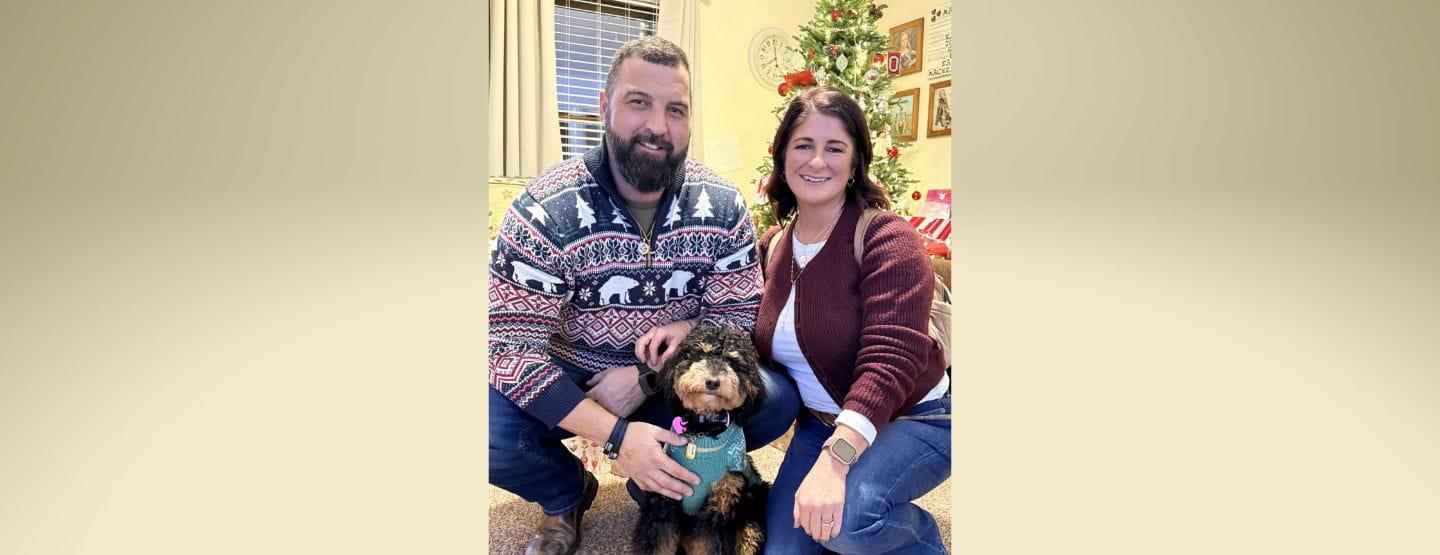
Two years ago, Stacey Mack was living a normal life. She was 42 and juggling the priorities of being a busy mom to a teenage boy. She loved hitting the gym with her husband and she loved to cook.
Today, life is anything but typical. Stacey’s heart is now powered by two three-pound batteries that she carries with her 24/7. Her heart failure experience was life-threatening, but a second opinion from Imad Hariri, MD at the ProMedica Heart Failure Clinic changed everything.
A Surprising Heart Failure Diagnosis
In October 2023, Stacey was convinced that she had come down with pneumonia. She went to urgent care to be treated, and while there, had a CT scan done of her chest.
“I remember the doctor coming in and telling me, ‘Well, you don’t have pneumonia, but you’re in heart failure,’” Stacey shares. “I couldn’t believe it. I hadn’t been experiencing any symptoms that would have made me think something more was going on.”
One of Stacey’s lungs was completely full of fluid, and the other was at 20% capacity. This happens with heart failure because of the weakened heart not being able to pump effectively. When this happens, blood and fluid backs up into the lungs' blood vessels.
Stacey was transferred to a local emergency room where they were able to stabilize her condition. She was diagnosed with non-ischemic cardiomyopathy — a type of heart muscle disease that isn’t caused by blocked arteries. She would later learn that this occurred because of a genetic mutation that she had inherited from her father.
At the time, she was told that she should be able to manage her condition with medications.
New Symptoms Leading to a Second Opinion
For several months, the medications seemed to be working. Stacey wasn’t having any new or worsening symptoms and was getting back to normal life. Until the spring of 2024, when Stacey began to vomit frequently.
For patients with heart failure, vomiting and other gastrointestinal symptoms can be a sign of fluid retention and poor blood flow to the gut, indicating that heart failure may be worsening.
A friend encouraged Stacey to get a second opinion with Daniel Cassavar, MD, a cardiologist with ProMedica Physicians. After his initial evaluation, he knew that Stacey was extremely sick and needed specialty care. Dr. Cassavar ordered Stacey to stop all activity (including driving) and referred Stacey to Imad Hariri, MD, with the ProMedica Heart Failure Clinic.
“I give Dr. Cassavar so much credit for recognizing that I needed specialty care and referring me to heart failure experts,” Stacey shared. “It all started with Dr. Cassavar.”
Getting Connected to Specialty Heart Failure Care
Within a couple of weeks, Stacey was at her appointment with Dr. Hariri at the ProMedica Heart Failure Clinic.
“I still remember that day,” Dr. Hariri shares. “Stacey came into my clinic and she looked awful. She looked deathly sick.”
After an evaluation, Dr. Hariri found that Stacey’s heart had weakened drastically in the few months since she had learned that she was in heart failure. Her heart was pumping at 15%, meaning that with each heartbeat, only 15% of the blood in her main heart chamber was being pumped out into her body. This measurement is called the ejection fraction (EF), which is normally 55 to 60% in healthy individuals.
Dr. Hariri quickly booked Stacey a room in the cardiac ICU at ProMedica Toledo Hospital. From there, the team immediately jumped into action.
Moving Fast to Save a Failing Heart
The team stabilized her condition by inserting a special kind of support pump through her groin.
“This got her heart working a little better,” Dr. Hariri shares. “But we quickly realized that Stacey either needed to be immediately listed for heart transplant or to have open heart surgery to implant a more durable heart pump to help her overcome the severe heart failure,” Dr. Hariri shares.
The best treatment option for Stacey, at the time, was to put in a mechanical pump called a left ventricular assist device (LVAD).
An LVAD is a power-supplied pump that is surgically implanted in the heart. A cable connects the pump in the heart to a controller outside the body. Then, another cable connects the controller to a set of batteries that the patient wears as a vest or backpack or plugs directly into home power. The LVAD needs continuous and uninterrupted power to function.
Essentially, the LVAD takes the place of the weakened heart muscle and moves oxygen-rich blood from the left ventricle to the ascending aorta. The LVAD can extend a patient’s life and improve the quality of life for those living with the most severe form of heart failure. In some instances, patients may later undergo a heart transplant if needed. More recently, a growing number of patients receive an LVAD that they use for the rest of their lives.
At present time, LVADs are not implanted at ProMedica or any other hospital in Northwest Ohio. Stacey had to be transferred to another hospital system at that time to receive this life-saving therapy.
Dr. Hariri partnered with colleagues at that system to make sure that Stacey received the care that she needed. He continues that partnership for local follow-up care in the Heart Failure Clinic to lessen Stacey’s travel load.
Dr. Hariri stresses the severity of Stacey’s situation: “Stacey could have died if she hadn’t been referred to us. We are truly fortunate at ProMedica to have the full suite of cardiac specialists in Toledo to be able to take care of sick patients like Stacey. As the area’s only Heart Failure Clinic staffed full time by advanced heart failure cardiologists and advanced practice providers, we bring patients expert care of heart failure right at home.”
Adjusting to a New Normal
It’s been two years since Stacey had her LVAD implanted. She hasn’t been hospitalized since, and she’s now active on the heart transplant list as she awaits a new heart to replace her heart and implanted pump.
“I’m spoiled with the care that I’ve received,” Stacey shares. “Dr. Hariri spends upwards of 40 minutes with me at every appointment just to see how I’m doing and what he can do to make things better. He even called me when I got home from the hospital after my procedure to check up on me and see how I was doing.”
While Stacey is listed for a heart transplant, she says that she hopes to avoid having one any time soon. Her LVAD is serving her well and she has physically and mentally recovered from the procedure. Dr. Hariri highlights that the LVAD technology has improved over time. There is less risk of adverse events from the pump that has allowed patients not only the opportunity to live longer, but have longer periods free of hospitalizations, device-related complications and better quality of life.
Stacey shares that the road to recovery was long and difficult. “For a young person with a kid, a husband and a job, it’s hard. You go from taking care of everyone else to everyone taking care of you. You must constantly carry around batteries, and you can’t get wet, so you can’t go swimming, can’t shower, can’t get stuck in the rain.”
Two years after her procedure, Stacey finally feels like she has adjusted. She’s back to doing a lot of the things that she loves, like cooking for her family, playing with their new puppy and spending time in the gym.
“There is life at the end of it. It takes a while, and you can never go back to your old normal, but you find a new normal that is well worth it,” Stacey shares.
Advanced Heart Failure Care, Right Here in Toledo, Ohio
“Patient stories, like that of Stacey’s, underline the importance of delivering advanced cardiac care right here at home,” Dr. Hariri adds.
Alexander Ghannam, MD, is a cardiothoracic surgeon with ProMedica Physicians who specializes in the surgical care of heart failure.
“When the heart becomes weak and medicine alone is no longer effective, we have surgical options to prolong people's lives,” shares Dr. Ghannam. “We look forward to bringing this technology and other therapies for heart failure to the area and being on the forefront of heart failure care.”
Imad Hariri, MD
Dr. Hariri is a heart failure specialist with the ProMedica Heart Failure Clinic. View his profile.
Alexander Ghannam, MD
Dr. Ghannam is a cardiothoracic surgeon with ProMedica Physicians. View his profile.
Daniel Cassavar, MD
Dr. Cassavar is a cardiologist with ProMedica Physicians. View his profile.
Subscribe to Our ProMedica Newsletter
Looking for inspiration on how to improve your health and well-being? Get trustworthy health news, wellness tips and inspirational patient stories delivered to your inbox twice a month with our free ProMedica newsletter.