When surgery is needed to treat breast cancer, it can be overwhelming. Learning more about the cancer, treatment options and what to expect can help patients face their course of treatment with confidence.
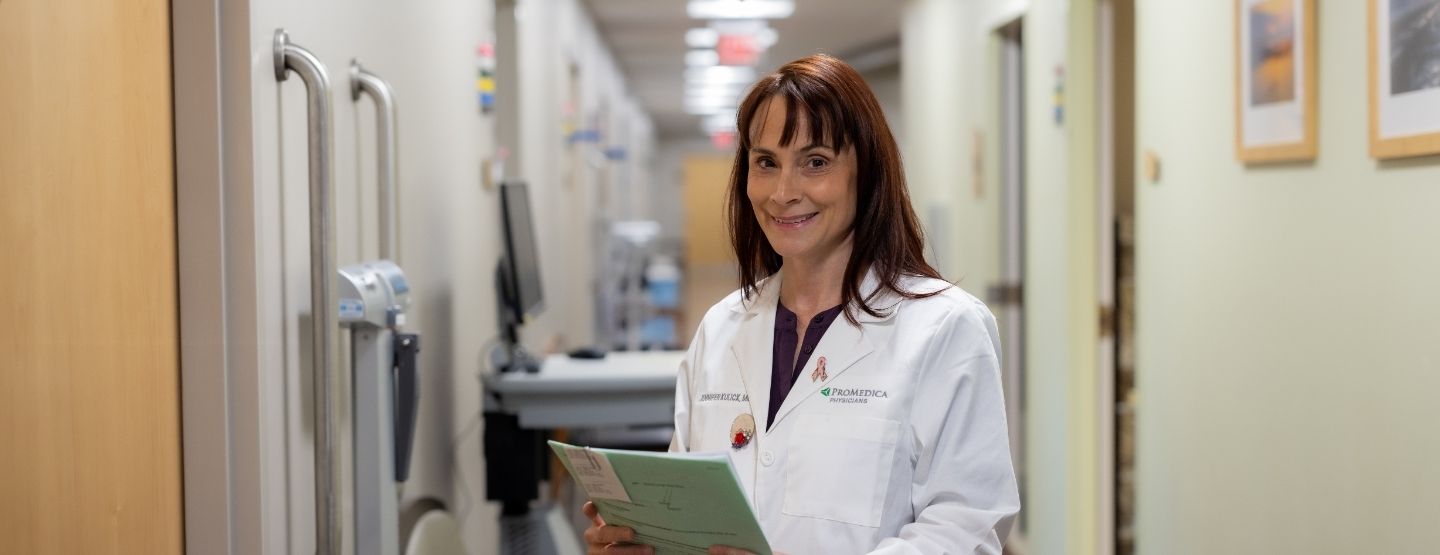
Jennifer Kulick, MD, FACS, with ProMedica Physicians Breast Surgery, says that meeting with the surgeon and care team can help ease fears.
“When patients come into the office, at least half or more are assuming that a bigger surgery will have a better result. That’s not always the case,” says Dr. Kulick. “There are lots of options to remove the cancer, depending on many factors. Not all patients will need chemotherapy or radiation, and knowing that is a relief for many patients.”
Lumpectomy vs. Mastectomy
There are two main types of breast cancer surgery: lumpectomy and mastectomy.
A lumpectomy is when the tumor and normal tissue around the tumor is removed, but the remainder is intact. A mastectomy is when the entire breast is removed, sometimes including the skin and nipple. A nipple sparing mastectomy is when the nipple is preserved.
“When it comes to lumpectomy or mastectomy, one type of surgery is not a better surgery than the other. Both, over time, have equal survival,” says Dr. Kulick. “But more recent data shows that patients tend to do better after lumpectomy. There’s not as much loss of sensation or body dysphoria. There are also lower complication rates.”
Some patients will also need their lymph nodes checked for potential removal, but Dr. Kulick says that surgeons try to minimize this. Lymph node removal can lead to lymphedema, a condition that causes swelling from fluid build-up. Removing multiple lymph nodes also typically doesn’t improve the prognosis, or outcome.
Choosing the Best Surgery for You
“Lumpectomy and mastectomy are the two surgical options, but within those options are many options,” explains Dr. Kulick. “Breast size, breast shape, tumor size, patient age, patient desires – these are all factors that go into deciding treatment options within a lumpectomy or mastectomy.”
Some patients wish to have the least downtime possible. Others are highly concerned about cancer recurrence. Some of Dr. Kulick’s patients may opt for a mastectomy, even if not needed, to minimize their risk. “If they are well informed and still make that decision, I support it,” says Dr. Kulick.
The most important thing is that patients have complete understanding of their cancer and their options.
“The first thing a surgeon should do is explain the biology or behavior of the patient’s cancer, because it’s not all the same,” says Dr. Kulick. “They should discuss all their options and be ready to answer questions about post-op care, recovery and long-term care. They should also talk about other treatments the patient will need, such as chemotherapy, radiation, long-term pills or endocrine therapy.”
Not all patients will need chemotherapy or radiation. If radiation is needed, it’s important to know it’s a local therapy. It doesn’t have full-body effects like chemotherapy. If an individual is having breast reconstruction surgery as well, the plastic surgeon will be part of the process to ensure a good outcome.
“We also offer all patients with a new diagnosis genetic testing,” says Dr. Kulick. “It can detect certain types of genetic mutations that may indicate a high risk for breast cancer again in the future. In that case, a patient may decide to have a double mastectomy. Genetic testing can also tell us if they are at risk for other types of cancer that we could be screening for or doing things to minimize the risk.”
Preparing for Breast Cancer Surgery
Most times, breast cancer is found through a screening or diagnostic mammogram. A radiologist performs a small biopsy to determine if the abnormal tissue is cancer. When the individual meets with the breast surgeon, additional imaging – MRI, molecular breast imaging (MBI), ultrasound – may be needed.
It can be tempting to search the internet for answers, but Dr. Kulick stresses the importance of working with your surgeon.
“Get all your questions together and write them down, since your mind may go blank in the office,” recommends Dr. Kulick. “Bring someone – at least one other person if not more – with you.”
Additionally, Dr. Kulick encourages smokers to quit smoking, as it will affect their healing, their anesthetic risk and the chance of cancer recurrence. If you’re active, stay active before your surgery.
Recovery and Beyond
Recovering from breast cancer surgery is different for every individual. It depends on the type of operation and the amount of tissue removed, as well as what else is being done, such as reconstruction.
Sometimes, drains may be needed after a bigger procedure to reduce fluid build-up for healing. There will also be activity and weight restrictions. Some individuals may need a week or two for recovery, while others may need eight to 12 weeks.
Other factors will affect recovery time and long-term treatment as well. Surgery may also be needed to remove lymph nodes. Individuals with a higher risk of lymphedema in their arm may need physical therapy to protect their arm.
Long-term, individuals with breast surgery may experience decreased sensitivity. Those who have had radiation may experience some changes in the chest wall, and those with reconstruction may need multiple procedures or a change in implants down the road. But patients are not alone in their journey.
“Breast surgeons all practice a little differently, but patients are typically followed for five years – with the surgeon, PA or CNP who specializes in breast health,” explains Dr. Kulick.
Patients may also see other cancer specialists or a cancer survivorship program after their cancer treatment. Programs like the ProMedica Survivorship Program provide follow-up care, resources and complementary therapies to help cancer survivors recover for years to come.
Jennifer Kulick, MD
Dr. Kulick is a breast surgeon with ProMedica Physicians Breast Surgery. View her profile.
Subscribe to Our ProMedica Newsletter
Looking for inspiration on how to improve your health and well-being? Get trustworthy health news, wellness tips and inspirational patient stories delivered to your inbox twice a month with our free ProMedica newsletter.